

The ‘abandoned’ NYC skyscrapers where the ultra-rich park their money
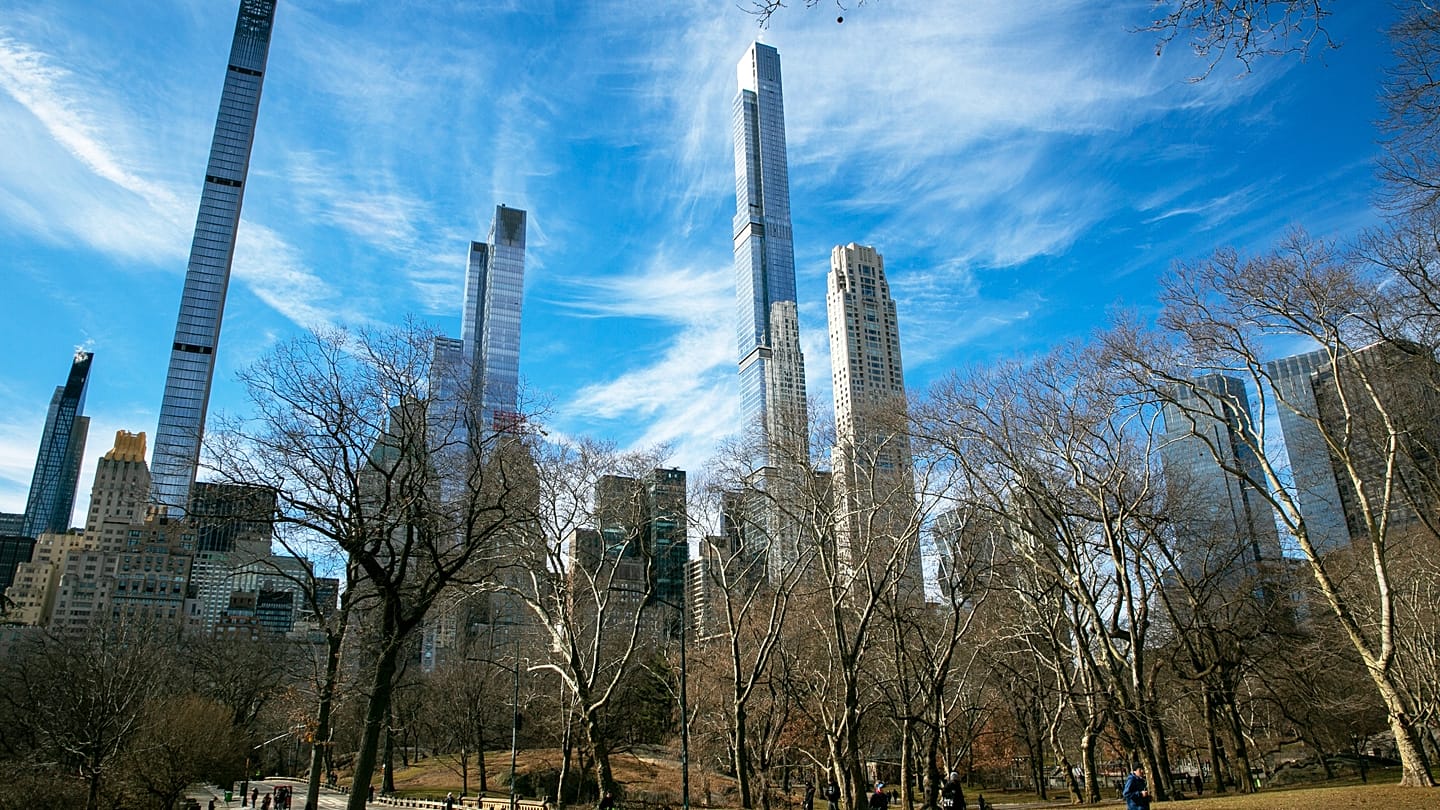
Billionaires’ Row, a cluster of luxury residential skyscrapers near the southern end of Central Park in New York City, is seemingly abandoned, according to estimates from established real estate firms.
Nearly half the apartments in the tallest seven residential towers in New York are currently empty, including Central Park Tower, completed in 2020 and the Western Hemisphere’s tallest residential building at more than 470 metres.Development in the area began in the early 2010s with buildings such as One57, 432 Park Avenue and 220 Central Park South. All of them came to market within the same decade, with Central Park Tower also being advertised before completion.With an average listing price of $30mn (€25.2mn), many units remain, unsurprisingly, unsold.Central Park Tower, for example, still had 87 unsold units in 2023. As of early 2025, Extell Development reportedly refinanced 18 unsold units with a $270mn (€227.6mn) loan, underscoring the persistently low sell-out rates.Yet most units that did sell ended up in the hands of the world’s ultra-rich, many of whom never moved in.‘Parking money’ in NYC skyscrapersFor billionaires around the world, these luxury real estate units function less as homes and more as real estate "safety deposit boxes", with the strategy seemingly focusing on capital preservation rather than profit generation.To begin with, cash is channelled into US dollar-denominated property, which can help shield wealth from inflation, currency volatility and political instability elsewhere. These assets can also be used as collateral when owners need liquidity.New York City real estate is widely viewed by the ultra-rich as a “safe haven” asset class, akin to gold or blue-chip art. Luxury homes in Manhattan, in particular, offer a stable store of value that is relatively insulated from economic shocks.Another factor is that these investments can provide portfolio diversification while preserving anonymity. Units are often bought through limited liability companies (LLCs), which can obscure the owner’s identity.That opacity is especially attractive to high-profile ultra-wealthy individuals who want to avoid public scrutiny of capital flows or to limit what tax authorities in their home countries can infer about their overall net worth.Finally, the “ghost tower” phenomenon. Units remain dark and uninhabited for most of the year, which is a calculated part of the strategy.For a billionaire, the potential rental income from a luxury apartment is often negligible compared to the hassle of managing tenants and the risk of "wear and tear" on a pristine asset. Keeping the unit empty ensures it remains in mint condition for a quick liquidation when cash is needed.Consequently, the apartment’s value lies in being owned rather than lived in, functioning as a liquid, transferable and mortgageable store of equity in one of the world’s most desirable property markets.The most exclusive neighbourhood on EarthResidents of Billionaires’ Row arguably form one of the most exclusive enclaves in the world. Yet they are unlikely to interact as neighbours, and many remain completely anonymous.The roster is heavily weighted towards American hedge fund titans and tech moguls.Ken Griffin, founder and CEO of Citadel, one of the world’s most successful hedge funds, made headlines in 2019 when he closed on a record-breaking $238mn (€200.6mn) quadruple penthouse at 220 Central Park South.Michael Dell, the founder and CEO of Dell Technologies, also bought into the strip. In 2014, he purchased a penthouse at One57 for $100.5mn (€84.7mn), which at the time was a record for the most expensive home sale in New York City.They are joined by other prominent names from the financial world, including Bill Ackman of Pershing Square Capital Management and Daniel Och, the chairman and former CEO of Och-Ziff Capital Management.Beyond American buyers, many of the towers are owned by members of the global elite.They include figures such as Saudi real estate magnate Fawaz Alhokair, who bought the highest residence at 432 Park Avenue, Hong Kong textile tycoon Silas Chou and Sting, the popular British crooner.Many of these owners come from old-money families and industrial dynasties across Asia, Europe and South America.Still, for every identifiable titleholder, there are dozens more hidden behind complex corporate structures.The result is a strange paradox where some of the most expensive square footage on Earth is legally owned by shell companies.What truly defines these owners is their transience. A billionaire might spend two weeks a year in a Manhattan penthouse before decamping to an estate in the Hamptons, a villa in Saint-Tropez or a flat in London’s Knightsbridge.As a result, the staff-to-resident ratio in these buildings is often strikingly high. Many operate with 24/7 white-glove concierge services and, in some cases, private chefs, keeping apartments in a permanent state of readiness even if the owner has not set foot inside for years.In that sense, Billionaires’ Row is full of “ghost residents” as well, owning the view but rarely appearing in the frame.Mamdani's crackdown on billionairesNew York City’s financial landscape faced a significant tremor last week as Mayor Zohran Mamdani presented his first preliminary budget since taking office at the start of the year.The mayor, who rose to power on a platform of radical affordability and a "crackdown" on billionaire exploitation, announced that the city is staring down a $5.4bn (€4.5bn) budget shortfall.To rectify this, Mamdani has proposed a "two-path" strategy that has immediately set the stage for a high-stakes political showdown with both the state government in Albany and the city’s real estate industry.The first path involves a significant increase in personal income taxes for the city’s wealthiest residents, specifically seeking a 2% increase on individuals earning more than $1mn (€850,000) annually to fund an ambitious social agenda.In what many observers describe as a tactical "nuclear option", Mamdani’s second path involves a 9.5% increase in the city's property tax rate, raising the average from 12.28% to approximately 13.45%.Mamdani has explicitly labelled this second option as a "last resort", stating that the city would only be forced down this "harmful path" if the state refuses to allow the city to "tax the rich".The proposal would affect more than 3 million residential units and 100,000 commercial properties across the five boroughs, potentially marking the first significant property tax hike in the city since 2003.The real estate sector and the City Council have reacted with predictable alarm, arguing that a 9.5% hike would inevitably trickle down to New York’s already burdened renters through higher costs passed on by landlords.While business advocacy groups fear the overhead will stifle economic recovery, Mamdani remains steadfast, arguing that the fiscal gap was inherited from years of mismanagement and that the city’s billionaire class must finally contribute their "fair share" to maintain essential municipal services.